The Best Time to Climb Mount Toubkal: A Month-by-Month Guide
By the Atlas Mountains Hike team
People ask Omar this more than any other question: when should I climb Toubkal? The honest answer is that North Africa’s highest peak (4,167 m) can be climbed all year — but the experience changes completely with the seasons. Here’s how each part of the year really feels on the mountain, from someone who grew up beneath it.
Quick answer: Toubkal month by month
| Month | Conditions | Verdict |
|---|---|---|
| Jan–Feb | Deep snow & ice above 3,000 m | Winter mountaineering only (crampons, axe, guide) |
| Mar | Snow softening, variable | Late-winter conditions; experienced only |
| Apr–May | Blossom in the valleys, snow on the summit cone | Best all-round — our top pick |
| Jun–Aug | Hot, dry, reliable, busy | Great if you don’t mind heat & company |
| Sep–Oct | Golden light, thinning crowds, stable trail | Excellent — the quiet classic |
| Nov–Dec | First lasting snow returns | Shoulder; winter kit from December |
Read on for what each season actually feels like.
Spring (April–May): our favourite window
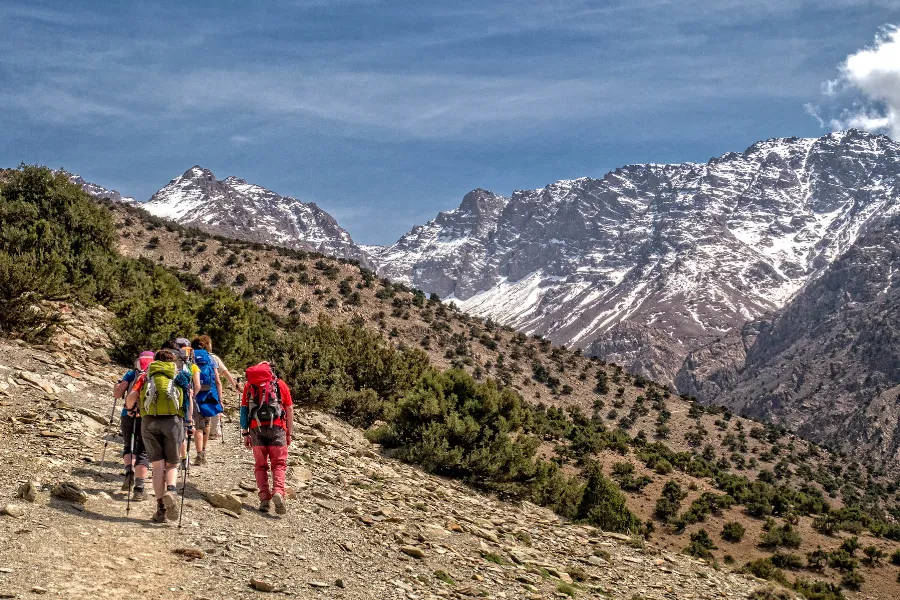
If you want one recommendation, this is it. By April the worst of the winter snow has softened, the days are long, and the lower valleys around Imlil explode into blossom — walnut, cherry, and apple trees in flower, fields of wild iris on the approach to Aroumd.
Up high you’ll still meet snow on the summit cone into May, which means crisp, photogenic conditions and, often, the mountain to yourselves. Daytime walking is comfortable; nights at the refuge are cold. It’s the season we point most first-time summiteers toward, and it suits the 2-day Mount Toubkal climb or, for better acclimatisation, the 3-day ascent.
Summer (June–August): long days, warm valleys
Summer is the busiest and most reliable season for weather. Skies are clear, the trail is dry, and there’s no snow to slow the final scree slopes. The trade-off is heat in the valleys — we start early, walk in the cool of the morning, and rest through the hottest hours.
This is also a fine time to combine the summit with a Berber villages trek or to stretch into a longer High Atlas discovery route, spending the warm evenings in village gîtes where the air cools quickly after dark.
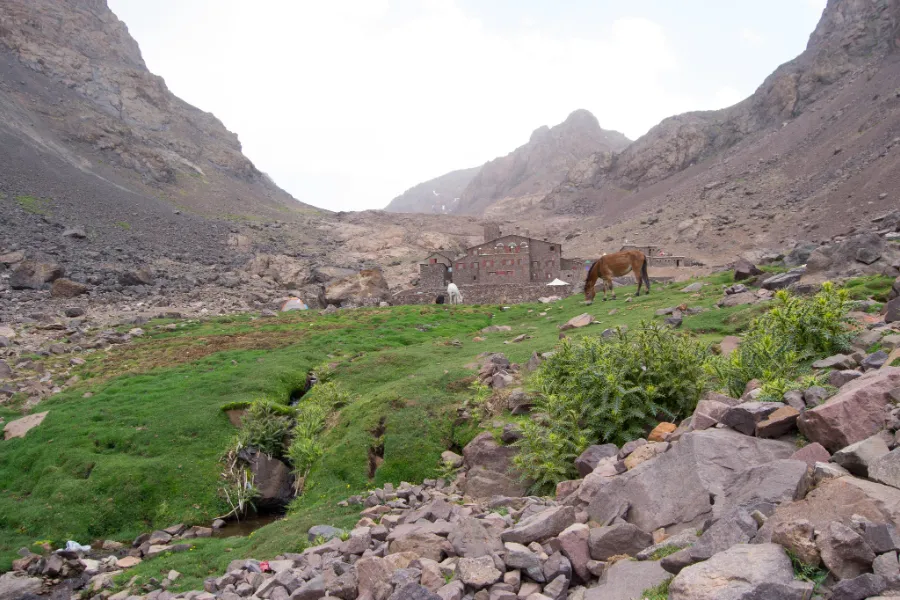 The Toubkal (Neltner) refuge, where most climbers spend the night before the dawn summit push.
Autumn (September–October): the quiet classic
Many of our guides quietly prefer autumn. The summer crowds thin out, temperatures settle into a comfortable range, and the light turns golden across the ridgelines. The ground is dry and stable, and the first dustings of snow can return to the summit by late October, giving you the best of both worlds.
It’s an ideal time for a combination trip — link Toubkal with the desert on our 5-day Toubkal and Sahara journey, travelling from snow-touched peaks to golden dunes in a single week.
Winter (November–March): a real mountaineering objective
Winter Toubkal is a different mountain. Above roughly 3,000 m the route holds snow and ice, and the final slopes require crampons and an ice axe — and the experience to use them. With the right kit and a guide, a winter summit is one of the most rewarding climbs in Morocco: silent, white, and spectacular.
We only run winter ascents for groups with appropriate gear and fitness, and we provide technical equipment and a guide trained for the conditions. If you’re drawn to winter, talk to us first so we can match the route to your experience.
What summit day actually looks like
Whatever the season, summit day follows a similar rhythm from the refuge (~3,200 m):
- 04:30–05:00 — Wake, quick breakfast, head-torches on.
- 05:00–09:00 — Climb the scree and (in season) snow to the Tizi n’Toubkal col at ~3,940 m, then the final ridge.
- 09:00–10:00 — Summit. Photos at the metal pyramid, panoramas across the Atlas and, on clear days, the haze of the Sahara.
- 10:00–13:00 — Descend to the refuge for lunch.
- Afternoon — Continue down to Imlil (2-day) or rest at the refuge (3-day).
Starting before dawn isn’t just tradition: it means stable morning snow, the best light, and a buffer if the weather turns in the afternoon.
A few practical notes
- Book ahead in peak season. The refuge and guide availability tighten over Easter, July–August, and the September weekends. Spring and autumn weekdays are quietest.
- Weather changes fast at altitude. Even in summer the summit can be near freezing with wind chill — your guide watches the forecast and will adjust timings for safety.
- Acclimatise if you can. The extra night on the 3-day ascent noticeably improves both comfort and summit success versus the faster 2-day climb. Not sure about fitness? Read how hard Mount Toubkal really is.
So, when should you go?
- First Toubkal, want comfort and colour: April–May or September–October.
- Guaranteed dry trail, don’t mind heat or company: June–August.
- A genuine snow-and-ice challenge: December–February, with technical kit.
Whatever the month, good general fitness, broken-in boots, and proper layers matter more than the calendar. Our guides handle the rest — navigation, pacing, refuge logistics, and the local knowledge that turns a climb into a journey.
Ready to pick your window? Browse our Toubkal treks or ask Omar which season fits your plans.
Ready to trek?
Browse our packages