
Travelling to the Moroccan Sahara: Tips for a Memorable Adventure
By the Atlas Mountains Hike team
There’s nothing quite like cresting the last rocky ridge and seeing the Sahara open out ahead — an ocean of golden dunes that turns rose and amber at sunset. The Moroccan desert is one of the great travel experiences, and it pairs beautifully with the Atlas Mountains. Omar’s team runs combined mountain-and-desert routes from Imlil; here’s how to do the desert well.
Quick answer: when to visit the Sahara
| Season | Conditions | Verdict |
|---|---|---|
| Oct–Apr | Pleasant days, cold nights, clear stars | Best for most travellers |
| May | Warming up, still workable | Good shoulder season |
| Jun–Aug | Intense midday heat | Early starts; not for everyone |
| Sep | Hot but easing | Fine with shade and hydration |
Pack for a big temperature swing: warm days, genuinely cold desert nights.
Getting there is part of the journey
Most desert trips travel the spectacular road south over the High Atlas via Tizi n’Tichka (2,260 m), past the kasbah of Telouet and the UNESCO-listed ksar of Aït Benhaddou, then on toward Ouarzazate, the Dadès valley, and the dunes of Erg Chebbi near Merzouga. The drive itself — mountains giving way to oases and then sand — is half the magic.
This is exactly the arc of our 5-day Toubkal and Sahara trip: summit the High Atlas, then cross to the edge of the desert in one journey.
| Leg | Roughly | Highlights |
|---|---|---|
| Marrakech → Aït Benhaddou | ~4 hrs | Tizi n’Tichka pass, Telouet kasbah, UNESCO ksar |
| Aït Benhaddou → Dadès | ~3 hrs | Ouarzazate, rose valley, gorges |
| Dadès → Merzouga (Erg Chebbi) | ~4 hrs | Date palmeries, first sight of the dunes |
It’s a long way east — most people do it over two to three days each way rather than as a dash. Merzouga (Erg Chebbi) has the tallest, most photogenic dunes; Zagora is closer to Marrakech but lower and less dramatic.
A night in a Berber camp
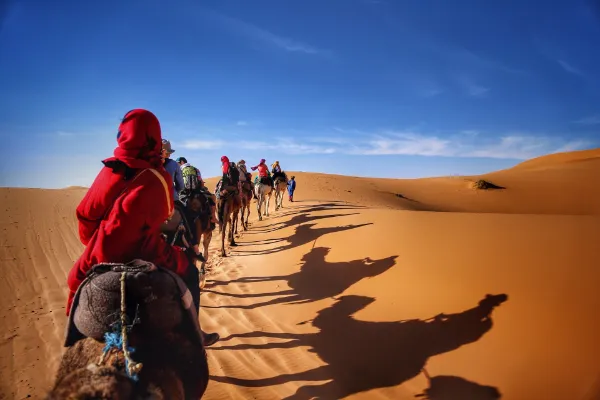
The heart of a Sahara trip is the overnight camp. You’ll usually ride a camel out over the dunes near sunset, reach a camp of traditional tents, share a tagine cooked over the fire, and fall asleep under a sky thick with stars — often to the sound of drums. Wake early for sunrise over the dunes; it’s worth the cold start.
A note on the camel ride: it’s shorter and bumpier than people expect — usually 45–90 minutes to camp, not hours. Wear long trousers to avoid chafing, hold the front of the saddle as the camel stands (it lurches forward then back), and know that you can always walk part of the way instead. Camps range from basic (shared tents, simple latrines) to comfort/“luxury” (private tents, beds, en-suite). Decide which you want before you book — the stars are the same either way.
Stay healthy in the desert: drink more water than feels necessary, protect against the sun relentlessly, and stick to bottled or treated water. The dry air and heat dehydrate you faster than you’ll notice.
What to pack
- Layers: breathable, skin-covering clothing for sun by day; a warm fleece or jacket for the night.
- A scarf or chèche — brilliant for sun, wind, and blowing sand.
- Hat, sunglasses, high-factor sun cream.
- A headlamp, refillable water bottle, and lip balm.
- Closed shoes for walking on dunes, plus sandals for camp.
For city-to-desert dressing in one trip, see our what to wear in Morocco guide.
Travel respectfully
The desert is home to Amazigh and nomadic communities whose way of life is shaped by this landscape. Go with a local operator, buy crafts directly from makers, carry out all your waste, and take time to learn a little of the culture and language — it turns sightseeing into something shared. More in our guide to Berber hospitality.
Mountains and desert
The Sahara is unforgettable on its own, but for many travellers the magic is the contrast — snow-touched peaks one day, golden dunes the next. If that appeals, look at our Toubkal and Sahara combination or ask Omar about tailoring a mountains-to-desert route to your dates.
Ready to trek?
Browse our packages