How Hard Is Mount Toubkal? Difficulty, Fitness & What to Expect
By the Atlas Mountains Hike team
Is Mount Toubkal hard? It’s the question Omar hears on almost every enquiry — and the honest answer is yes, but it’s achievable for most fit hikers. At 4,167 m, Toubkal is North Africa’s highest peak. It’s not a technical climb in summer, but altitude, long days, and steep scree make it a real mountain objective — not a stroll from Marrakech.
Here’s what difficulty actually feels like on the trail, how to prepare, and which route suits your experience.
Quick answer: how hard is Toubkal?
| Factor | Summer (Apr–Oct) | Winter (Nov–Mar) |
|---|---|---|
| Technical skill | Low — walking with poles | Moderate — crampons & ice axe required |
| Fitness needed | Moderate to high | High |
| Typical rating | Moderate–strenuous | Challenging |
| Summit day duration | 8–10 hours | Similar, slower in snow |
| Altitude risk | Real above 3,000 m | Same, plus cold exposure |
Bottom line: If you can hike 15–20 km on hilly terrain in a day and you’re willing to start before dawn on summit day, the 2-day Mount Toubkal climb is within reach. If altitude or fitness is a concern, the 3-day ascent is the smarter choice.
Why Toubkal feels harder than the altitude number suggests
1. The summit day is long
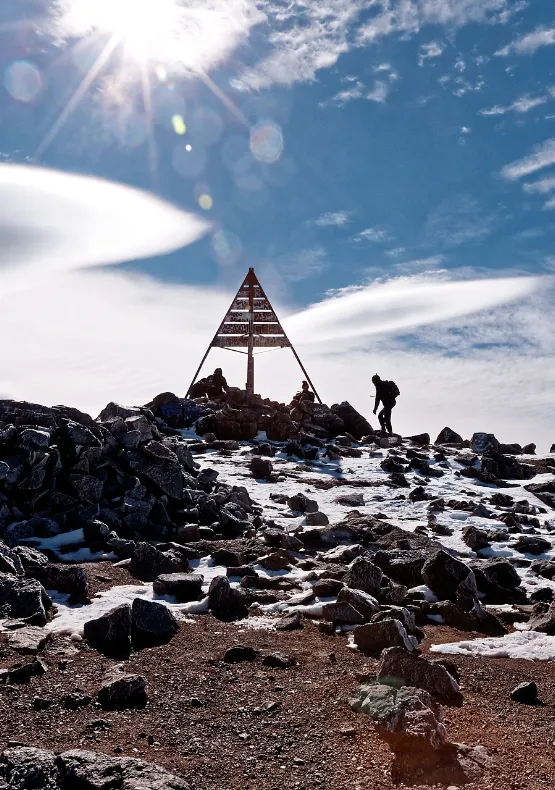
Most people underestimate day two. From the refuge (~3,207 m), you climb roughly 960 m to the summit, then descend all the way back to Imlil — often 8–10 hours on your feet with a headtorch start around 05:00.
The climb itself isn’t rock climbing, but the final scree slopes are steep, loose, and relentless. Coming down is hard on knees and quads.
2. Altitude affects everyone differently
Above 2,500 m, thinner air makes every step feel heavier. Common symptoms include shortness of breath, mild headache, and fatigue — even in fit hikers. Our guides pace the group, build in rest stops, and watch for signs of altitude sickness.
Tip: The 3-day route adds an acclimatisation day (including the Isk viewpoint area) before the refuge. First-timers summit more comfortably with that extra night on the mountain.
3. You’re carrying fatigue from day one
Day one is 5–6 hours uphill from Imlil to the refuge — through villages, mule paths, and a steady gain of about 1,470 m. You sleep in a shared mountain refuge, often with early noise and cold air. Summit day starts before you’ve fully recovered.
Day-by-day difficulty breakdown (standard 2-day route)
Day 1: Imlil → Toubkal refuge
- Distance: ~12 km
- Time: 5–6 hours
- Difficulty: Moderate uphill — well-marked trail, mule paths, some rocky sections
- Altitude: 1,740 m → 3,207 m
This day is manageable for most active travellers. The challenge is sustained ascent, not technical terrain.
Day 2: Summit → back to Imlil
- Distance: ~19 km total (refuge → summit → refuge → Imlil)
- Time: 8–10 hours
- Difficulty: Strenuous — pre-dawn start, steep scree, long descent
- Altitude: Up to 4,167 m, then back to 1,740 m
This is the day that defines the trek. Fitness, mental stamina, and pacing matter more than speed.
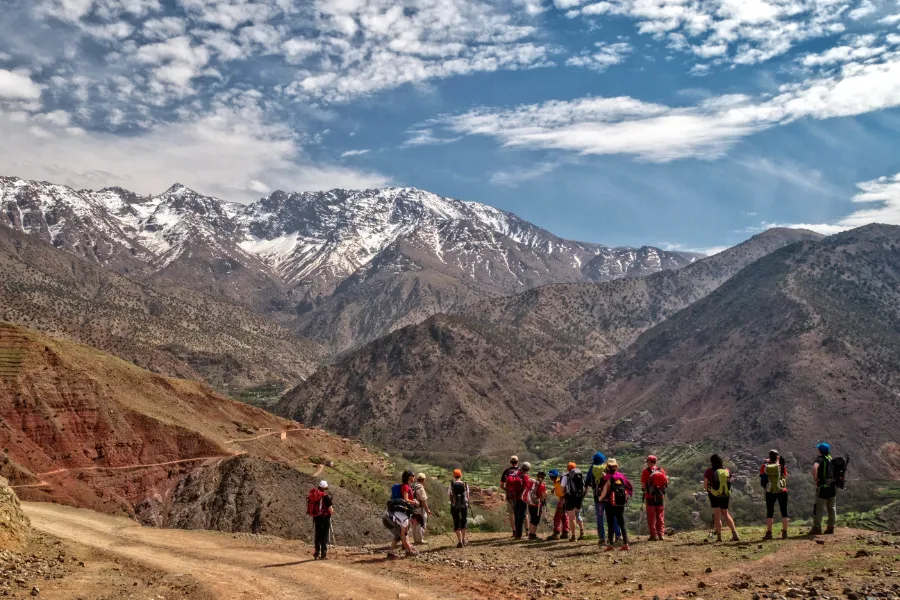 The reward: panoramic views from the High Atlas — but you earn them on summit day.
Do you need climbing experience?
Summer (April–October): No ropes, harnesses, or climbing skills required. Sturdy boots, trekking poles, warm layers, and a headtorch are essential. A licensed guide is mandatory for all groups on Toubkal.
Winter (November–March): A different proposition. Snow and ice above ~3,000 m mean crampons and an ice axe — and the skills to use them. We only run winter ascents for appropriately equipped groups with experienced guides.
How fit do you need to be?
You don’t need to be an athlete, but you should:
- Walk 3–4 hours comfortably on uneven ground
- Handle consecutive long days without joint pain
- Train in the 8–12 weeks before with hills, stairs, or loaded day hikes
Cardio helps (running, cycling, swimming), but hiking-specific training matters most — especially downhill practice. See our training guide for a simple 8-week plan.
2-day vs 3-day: which is easier?
| 2-day climb | 3-day ascent | |
|---|---|---|
| Best for | Fit hikers short on time | First-timers, altitude-sensitive hikers |
| Acclimatisation | Minimal | Extra day at altitude |
| Summit success | Good with fitness | Better for most people |
| Time in Marrakech | Less | One extra day on mountain |
Neither route is “easy” — the 3-day option spreads the load and gives your body time to adjust. For a full side-by-side itinerary comparison, read 2-day vs 3-day Mount Toubkal.
Common mistakes that make Toubkal feel harder
- Underestimating summit day — treat it as a marathon, not a morning hike.
- New boots on the trail — blisters end treks; break boots in beforehand.
- Skipping layers — summit wind chill near freezing even in summer.
- Rushing at altitude — slow and steady beats fast and sick.
- Choosing 2 days when 3 would suit you — honesty about fitness saves the summit.
Is Toubkal harder than Kilimanjaro or other peaks?
Toubkal is lower than Kilimanjaro (5,895 m) and usually completed in 2–3 days rather than a week. But the summit day intensity is comparable — steep, long, and at meaningful altitude. Many guests who found Toubkal challenging still describe it as one of their best travel experiences.
Ready to climb?
Toubkal is hard enough to feel like a genuine achievement, but accessible enough that thousands of hikers reach the summit each year with the right preparation and a good guide.
- Confident and fit? → 2-day Mount Toubkal trek
- Want a gentler build-up? → 3-day Toubkal ascent
- Budgeting the trip? → How much does a Mount Toubkal trek cost?
- Still unsure? → Ask Omar — he’ll recommend the right route for your dates and fitness.
For season-by-season timing, read the best time to climb Mount Toubkal. For kit, see what to wear in Morocco and our trek page kit lists.
Ready to trek?
Browse our packages